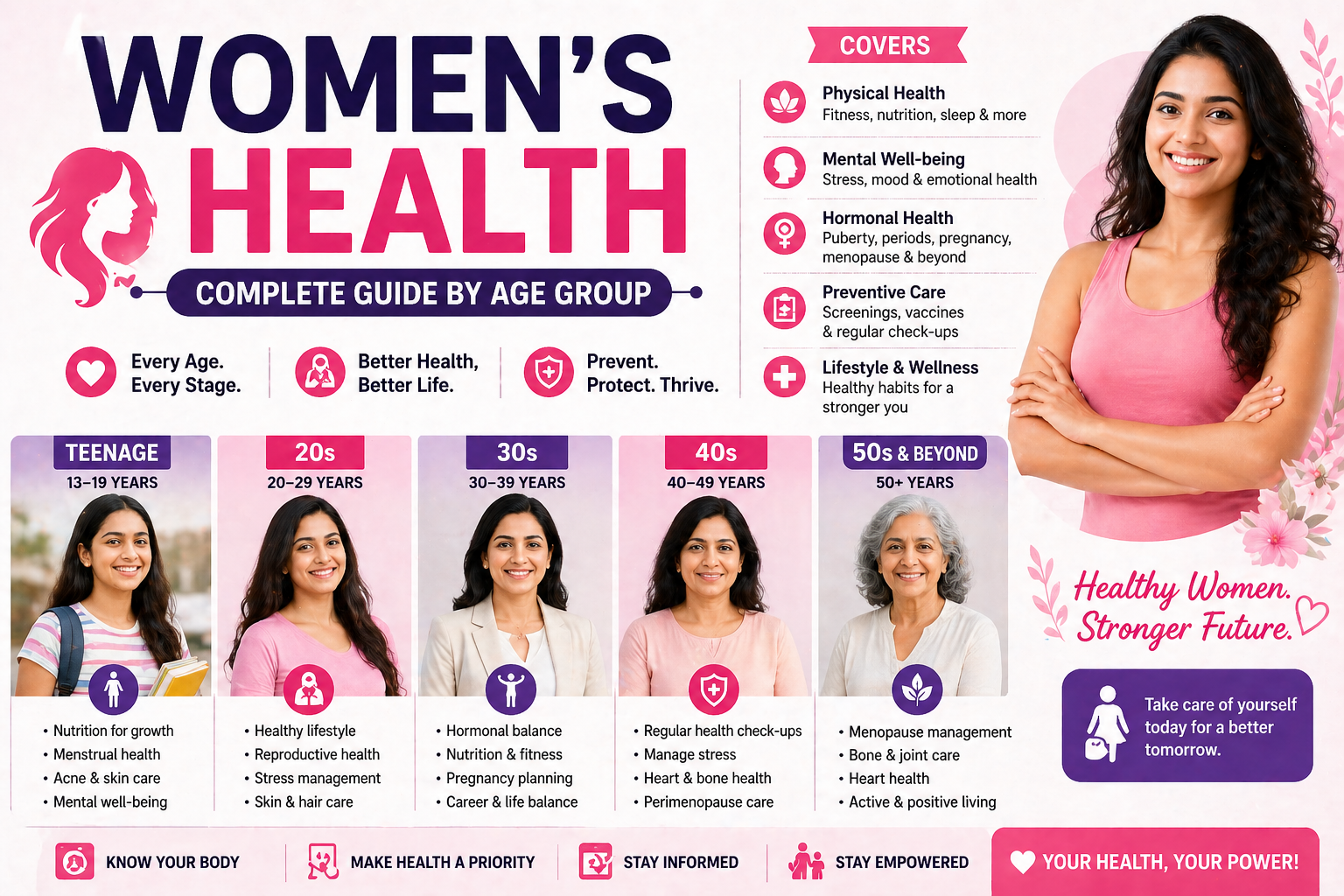
A woman’s body is not static it evolves constantly, decade by decade, through remarkable biological transitions. The health priorities of a 20-year-old are fundamentally different from those of a 40-year-old or a 60-year-old. Yet most general health advice treats women as a single, unchanging group.
That’s a mistake.
Understanding what your body needs at each stage of life is one of the most powerful things a woman can do for her long-term health. This guide breaks it all down clearly, honestly, and completely from your twenties through your sixties and beyond.
Because women’s health is not a single chapter. It’s an entire book. At PrimePulse, we’ve covered many pieces of this puzzle already. If you’re building a strong health foundation, start with what you eat our guide on the best foods to boost your immune system is essential reading. Physical strength matters too especially as women age so our guide on how to improve athletic performance naturally is equally relevant.
For any specific health questions, feel free to contact the Polishit team directly.
Why Women’s Health Needs a Different Conversation
Women face unique health challenges that are often underdiagnosed, undertreated, or dismissed entirely. Research consistently shows that:
- Women are more likely to be misdiagnosed during heart attacks because their symptoms differ from men’s.
- Autoimmune diseases affect women at nearly 3x the rate of men.
- Mental health conditions like anxiety and depression are twice as prevalent in women.
- Women experience hormonal shifts at puberty, pregnancy, perimenopause, and menopause each carrying distinct health implications
A one-size-fits-all approach to health simply doesn’t serve women. Here’s what it actually does:
In Your 20s Build the Foundation
Your twenties are your biological peak in many ways but they’re also when lifelong habits form. The choices you make now will echo for decades.
Key Health Priorities
Establish a relationship with a doctor. Many women in their twenties skip annual checkups entirely. This is a mistake. Baseline blood work, blood pressure readings, and pelvic exams establish the data points that will matter deeply later.
Reproductive health awareness
- Begin Pap smears at age 21 (every 3 years if normal)
- Discuss contraception options with a gynecologist not all methods suit all bodies
- Understand your menstrual cycle irregularity can signal thyroid issues, PCOS, or nutritional deficiencies
Bone density start now. Peak bone mass is reached in your late twenties. Calcium (1,000 mg/day) and vitamin D are non-negotiable. Weight-bearing exercise walking, running, and strength training builds the bone density you’ll rely on in your fifties and sixties.
Mental health: Anxiety and depression often first appear in the twenties. Normalize therapy. Normalize asking for help. Untreated mental health conditions compound significantly over time.
Nutrition and fitness Establish consistent exercise habits and a nutrient-rich diet now. Metabolism begins slowing in the late twenties what worked at 22 may not work at 28.
💡 Screening Checklist for Your 20s:
- Annual physical exam
- Pap smear (every 3 years)
- Blood pressure check
- STI screening if sexually active
- Skin check (especially with sun exposure history)
- Mental health assessment
In your 30s Protect and Sustain
Your thirties bring new complexity career pressure, relationship demands, and often pregnancy and motherhood. Your body is still resilient, but it’s beginning to signal that it needs more intentional care.
Key Health Priorities
Pregnancy and preconception health If motherhood is part of your plan, your thirties are the prime decade but fertility does begin declining after 35. Preconception care matters enormously:
- Folic acid (400–800 mcg daily) reduces neural tube defects
- Manage thyroid health thyroid disorders are common in women and directly affect fertility
- Screen for gestational diabetes risk factors
Postpartum health often overlooked Postpartum depression affects 1 in 5 new mothers. It is not weakness. It is a medical condition that requires treatment. Thyroid dysfunction also commonly develops post-pregnancy.
Cardiovascular health earlier than you think Heart disease is the leading cause of death in women worldwide yet most women don’t think about it until their fifties. Your thirties are the time to establish the following:
- Blood pressure monitoring
- Cholesterol baseline (first lipid panel by age 35)
- Blood sugar levels
Skin and hormonal changes Collagen production begins declining around age 30. Sun protection becomes increasingly important not cosmetically, but for skin cancer prevention.
💡 Screening Checklist for Your 30s:
- Annual physical + Pap smear (every 3 years, or every 5 with an HPV co-test)
- Lipid panel (by 35)
- Blood glucose screening
- Thyroid function test
- Mental health check especially postpartum
In Your 40s The Pivot Decade
The forties are often where women first feel the physical signals of significant change. Perimenopause typically begins in the mid-to-late forties. Metabolism shifts become more pronounced. And health risks that were theoretical in your twenties become statistically real.
Key Health Priorities
Perimenopause understand it early. Perimenopause is the transition phase before menopause it can last 4–10 years. Symptoms include:
- Irregular periods
- Hot flashes and night sweats
- Sleep disruption
- Mood changes, brain fog
- Decreased libido
Many women don’t realize perimenopause has begun because symptoms are subtle at first. Track your cycle. Discuss hormonal changes openly with your doctor.
Breast health
- Mammograms: Most guidelines recommend beginning annual mammograms at age 40–45.
- Perform monthly breast self-exams
- Know your family history BRCA gene mutations significantly elevate risk
Bone density screening Estrogen plays a major role in bone density. As estrogen begins declining in perimenopause, bone loss accelerates. Ensure adequate calcium, vitamin D, and weight-bearing exercise the habits you hopefully built in your twenties.
Metabolic health: Insulin resistance increases with age and hormonal change. Prioritize:
- Reducing refined sugar and processed carbohydrates
- Strength training to maintain muscle mass (muscle burns more calories at rest)
- Regular blood glucose monitoring
Eye and dental health Both deteriorate more noticeably in the forties. Annual eye exams and regular dental checkups are essential.
💡 Screening Checklist for Your 40s:
- Annual mammogram (from age 40–45)
- Pap smear + HPV test (every 5 years)
- Bone density scan if risk factors present
- Comprehensive metabolic panel
- Blood pressure and cholesterol annually
- Colorectal cancer screening discussion with doctor
In Your 50s Menopause and Beyond
Menopause, defined as 12 consecutive months without a period, typically occurs between ages 45 and 55. It is not a disease. It is a natural biological transition. But it does bring significant changes that require intentional management.
Key Health Priorities
Managing menopause symptoms Common symptoms include hot flashes, vaginal dryness, sleep problems, weight gain, and mood changes. Options include:
- Hormone Replacement Therapy (HRT) effective for many women; discuss risks and benefits with your doctor
- Non-hormonal options certain antidepressants, gabapentin, and lifestyle modifications
- Phytoestrogens found in soy, flaxseed, and legumes; may mildly reduce symptoms
Cardiovascular risk rises sharply. After menopause, a woman’s heart disease risk increases dramatically estrogen was providing protective cardiovascular effects. Now, heart health becomes the single most important medical priority:
- Control blood pressure aggressively
- Manage cholesterol with diet, exercise, and medication if needed
- Don’t smoke ever
Osteoporosis prevention: Bone loss accelerates sharply post-menopause. A DEXA scan (bone density test) should be done by age 65 earlier if risk factors exist. Calcium, vitamin D, weight-bearing exercise, and, in some cases, medication are essential.
Cognitive Health: Women are diagnosed with Alzheimer’s disease at nearly twice the rate of men. Protective strategies include:
- Regular aerobic exercise
- Social connection and mental stimulation
- Quality sleep
- Managing blood pressure and blood sugar
💡 Screening Checklist for Your 50s:
- Annual mammogram
- Colonoscopy (every 10 years starting at 50, or earlier with family history)
- DEXA bone density scan
- Comprehensive cardiovascular panel
- Diabetes screening
- Eye exam annually
In Your 60s and Beyond Thriving, Not Just Surviving
The sixties and beyond are not a time to simply manage decline they’re a time to actively invest in quality of life. Women who prioritize health in this decade consistently report higher energy, independence, and life satisfaction.
Key Health Priorities
Falls and fracture prevention Falls are the leading cause of injury-related death in older adults. Priorities:
- Strength and balance training (yoga, tai chi, resistance training)
- Home safety assessment remove trip hazards, improve lighting
- Vision correction many falls are linked to uncorrected vision changes
Cognitive health monitoring Mild cognitive changes are normal with aging significant memory loss is not. Early diagnosis of dementia allows for better management and planning.
Social health profoundly underrated Loneliness and social isolation are associated with increased risk of heart disease, depression, cognitive decline, and premature death. Maintaining strong social connections is a genuine health strategy.
Medication management: Many older adults take multiple medications a situation called “polypharmacy” which increases the risk of dangerous interactions. Review all medications with your doctor annually.
Conclusion: Your Health, Your Timeline
Women’s health is not a single conversation it’s a lifelong relationship between you and your body. Each decade brings new challenges, new priorities, and new opportunities to invest in yourself.
The thread that runs through every age group is this: be proactive, not reactive. Don’t wait for symptoms. Don’t dismiss what your body is telling you. Don’t put your own health last on the list.
You cannot pour from an empty cup. Taking care of your health isn’t selfish it’s the foundation everything else is built on.
For a stronger physical foundation at any age, revisit our guides on how to improve athletic performance naturally and the best foods to boost your immune system.
Have questions specific to your health journey? Contact the Polishit team we’re here to help you find the right resources and guidance.