Walk into any supplement store, and you’ll be overwhelmed instantly—hundreds of products, bold claims, and price tags that make your wallet nervous. The fitness supplement industry is worth billions of dollars, and much of it is built on hype, clever marketing, and ingredients that have little to no scientific backing.
But here’s the thing: a small handful of supplements actually work. They are backed by decades of peer-reviewed research, used by elite athletes worldwide, and safe for long-term use when taken correctly.
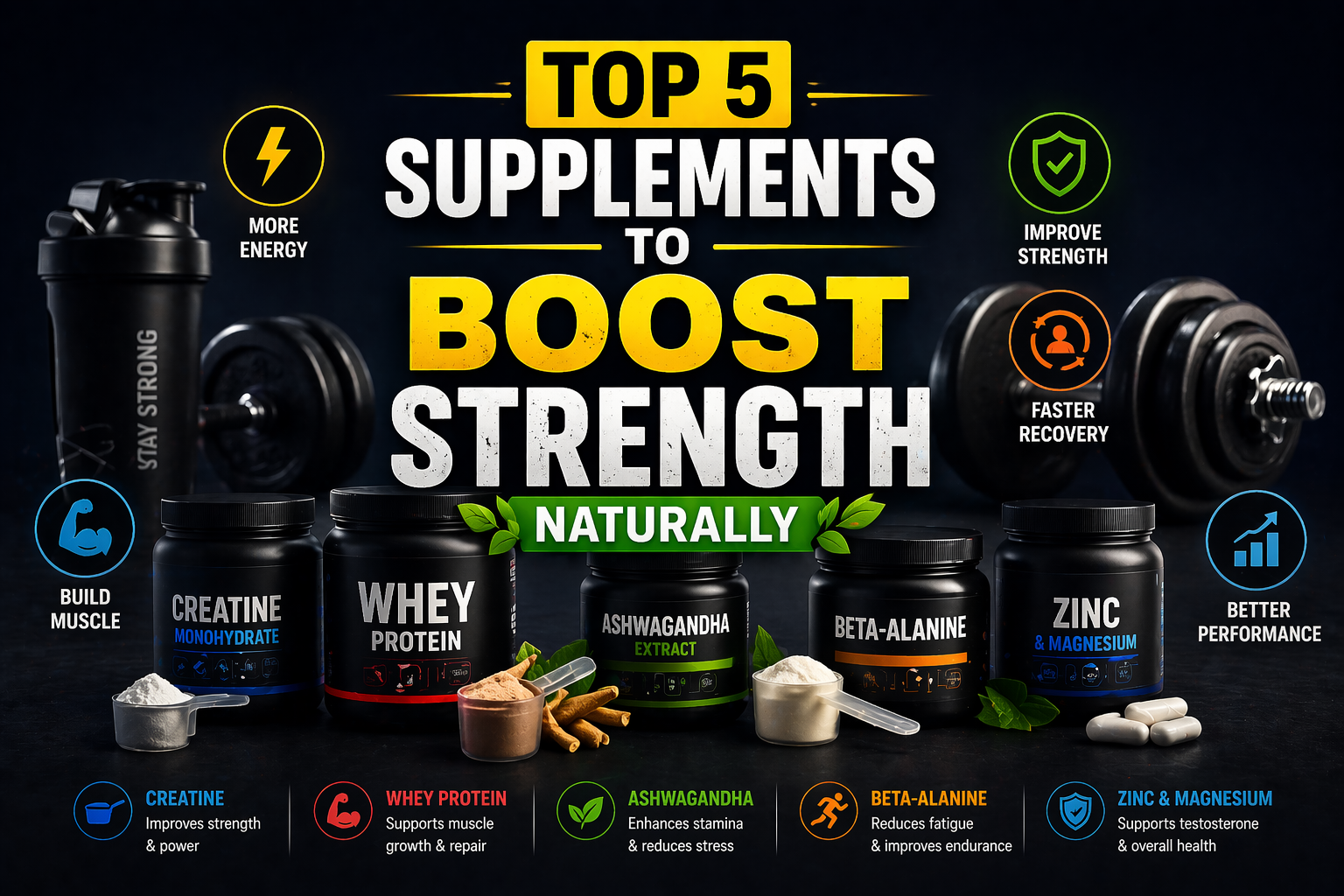
This guide cuts through the noise. We’re giving you the top 5 supplements that genuinely boost strength naturally — what they are, how they work, what the science says, and exactly how to use them.
Before we dive in, it’s worth noting that supplements are only as effective as the foundation beneath them. Your training, sleep, and nutrition must be dialed in first. If you haven’t read our guide on how to improve athletic performance naturally, start there—it covers the non-negotiable basics every serious athlete needs. And for the nutritional side of strength building, our breakdown of the best foods to boost your immune system shows how real food creates the environment where supplements can actually do their job.
Why Most Supplements Don’t Work
Before revealing what does work, let’s be honest about the industry.
The vast majority of supplements on the market are either
- Underdosed—they contain the right ingredient but in amounts too small to produce any effect
- Proprietary blends — a mix of ingredients listed together without individual doses, hiding the fact that most are present in trace amounts
- Unsupported by evidence — backed by one poorly designed study, or no study at all
- Relying on a placebo—they work because you believe they work, not because of any physiological mechanism
The supplements on this list are different. Each one has been studied extensively, replicated across multiple independent trials, and shown to produce measurable, real-world results.
Supplement #1: Creatine Monohydrate — The King of Strength
If you could only take one supplement for strength, it would be creatine monohydrate. It is the single most researched sports supplement in existence—with over 500 peer-reviewed studies supporting its effectiveness and safety.
How It Works
Your muscles use a molecule called ATP (adenosine triphosphate) as their primary energy currency during explosive, high-intensity movements—lifting, sprinting, and jumping. ATP depletes rapidly, and your muscles fatigue.
Creatine replenishes phosphocreatine stores in your muscles, allowing faster ATP regeneration. The result: you can lift heavier, do more reps, and recover faster between sets.
What the Research Shows
- Increases strength and power output by 5–15% on average
- Improves performance in high-intensity, short-duration activities
- Supports muscle mass gains over time when combined with resistance training
- Safe for long-term use — no evidence of kidney or liver harm in healthy individuals
How to Take It
- Dose: 3–5 grams daily
- Form: Creatine monohydrate — the cheapest and most studied form. Avoid expensive “enhanced” versions—they offer no additional benefit.
- Loading phase: Optional — 20g/day for 5–7 days to saturate faster, then drop to 3–5g
- Timing: Doesn’t matter much—consistency is more important than timing
- With or without food: Fine either way; some people prefer it with a carb-containing meal for slightly better uptake
💡 Bottom Line: If you’re serious about building strength naturally, creatine monohydrate is non-negotiable. It works. Period.
Supplement #2: Protein Powder — Convenience, Not Magic
Protein powder is not a miracle supplement — it’s simply a convenient, affordable way to hit your daily protein targets. And hitting your protein targets is absolutely essential for strength and muscle development.
How It Works
Muscle repair and growth require amino acids — the building blocks of protein. After resistance training, your muscles enter a state of protein synthesis, actively rebuilding stronger than before. Without adequate protein, this process is severely limited.
Types of Protein Powder
| Type | Best For | Notes |
|---|---|---|
| Whey Protein | Fast absorption, post-workout | Most studied, complete amino acid profile |
| Casein Protein | Slow release, before bed | Sustained amino acid delivery overnight |
| Plant Protein | Vegan/vegetarian athletes | Pea + rice combination gives complete profile |
What the Research Shows
- Protein supplementation combined with resistance training produces significantly greater muscle mass and strength gains than training alone.
- Whey protein in particular stimulates muscle protein synthesis more effectively than other sources due to its high leucine content.
- Total daily protein intake matters more than timing—though consuming protein within 2 hours post-workout is beneficial
How to Take It
- Dose: Enough to reach your total daily target of 1.6–2.2 g per kg of body weight
- Timing: Post-workout is ideal, but any time of day works if total intake is met.
- What to look for: Minimal ingredients, 20–30g protein per serving, low sugar
Supplement #3: Caffeine — The Legal Performance Enhancer
Caffeine is the most widely consumed psychoactive substance on earth—and one of the most effective natural performance enhancers available. Unlike many supplements, its effects are immediate and well-documented.
How It Works
Caffeine blocks adenosine receptors in the brain—adenosine is the compound responsible for making you feel tired. By blocking it, caffeine increases alertness, reduces perceived effort, and enhances both mental and physical performance.
For strength training specifically, caffeine has been shown to:
- Increase muscular strength and endurance
- Reduce perceived exertion — the same workout feels easier
- Improve focus and mind-muscle connection
- Enhance fat oxidation during exercise
What the Research Shows
- Performance improvements of 3–16% in strength and endurance tasks
- Effective for both aerobic and anaerobic activities
- Benefits are seen with doses as low as 3 mg per kg of body weight
How to Take It
- Dose: 3–6 mg per kg of body weight (for a 70 kg person, that’s 210–420 mg)
- Timing: 45–60 minutes before training
- Best sources: Black coffee, green tea, or pure caffeine capsules
- Important: Cycle caffeine—take 1–2 weeks off every 6–8 weeks to prevent tolerance buildup
- Avoid: Taking it after 2pm if it disrupts your sleep—and remember, poor sleep destroys strength gains faster than any supplement can build them.
Supplement #4: Beta-Alanine — Train Harder, Longer
Beta-alanine is an amino acid that has become increasingly popular among strength and endurance athletes—and for good reason. It directly delays the onset of muscular fatigue during high-intensity training.
How It Works
During intense exercise, hydrogen ions accumulate in your muscles, causing the burning sensation that forces you to stop. Beta-alanine increases carnosine levels in muscles — and carnosine buffers these hydrogen ions, delaying fatigue and allowing you to push harder for longer.
What the Research Shows
- Significantly improves performance in exercises lasting 1–4 minutes—making it especially useful for high-rep strength sets, circuit training, and metabolic conditioning
- Increases total training volume over time, which drives long-term strength and muscle gains
- Particularly effective when combined with creatine
How to Take It
- Dose: 3.2–6.4 grams daily, split into smaller doses
- Timing: Daily use — effects are cumulative, not acute
- The tingling: Beta-alanine causes a harmless skin tingling sensation called paresthesia. It’s completely safe and fades with regular use. If it bothers you, split doses into smaller amounts throughout the day.
Supplement #5: Ashwagandha — The Adaptogen That Actually Delivers
Ashwagandha is an ancient Ayurvedic herb that has earned genuine respect in modern sports science. Unlike most “natural” supplements that fail under scrutiny, ashwagandha’s benefits for strength and performance hold up remarkably well in clinical trials.
How It Works
Ashwagandha is an adaptogen — a compound that helps the body manage and recover from physical and psychological stress. It works primarily by reducing cortisol, the stress hormone that, when chronically elevated, suppresses testosterone, slows recovery, increases fat storage, and breaks down muscle tissue.
Lower cortisol = better recovery = more strength gains over time.
What the Research Shows
- A landmark study found that men taking ashwagandha for 8 weeks gained significantly more muscle mass and strength than the placebo group.
- Improves VO₂ max—a measure of cardiovascular efficiency critical for sustained athletic performance
- Reduces exercise-induced muscle damage and speeds up recovery
- Shown to increase testosterone levels in men with low-normal testosterone
This connection to cortisol and stress management is also deeply relevant to overall well-being—particularly for women navigating major hormonal transitions, as we explored in our complete guide to women’s health by age group.
How to Take It
- Dose: 300–600 mg of a root extract standardized to withanolide content (look for KSM-66 or Sensoril on the label—the most studied forms)
- Timing: Can be taken any time; many prefer evenings, as it has mild calming effects
- Results: Allow 4–8 weeks of consistent use before evaluating
How to Stack These Supplements Effectively
Used together, these five supplements create a powerful, natural performance stack:
| Time | Supplement |
|---|---|
| Morning (daily) | Creatine 3–5g + Ashwagandha 300mg |
| Pre-workout (45–60 min before) | Caffeine 200–300mg + Beta-Alanine 1.6g |
| Post-workout | Protein shake 25–30g |
| Evening (daily) | Beta-Alanine remaining dose |
💡 Important Note: Always introduce one supplement at a time — wait 2 weeks before adding the next. This lets you assess how your body responds to each individually and identify any sensitivities.
What to Look for When Buying Supplements
The supplement industry is largely unregulated in most countries. Protect yourself:
- Third-party tested: Look for NSF Certified for Sport, Informed Sport, or USP verification
- Single ingredients: Avoid “proprietary blends” that hide individual doses
- Minimal additives: The shorter the ingredient list, the better
- No outrageous claims: If it promises to “triple your testosterone in 7 days,” it’s a scam
Conclusion: Supplements Support, They Don’t Replace
The supplements on this list work but only within a strong overall health framework. Creatine won’t save a poor diet. Protein powder can’t compensate for chronic sleep deprivation. Ashwagandha won’t overcome a training program that isn’t progressive.
Build the foundation first. Train consistently. Sleep 8 hours. Eat whole, nutrient-dense foods. Manage stress. Then add these supplements to amplify what you’re already doing and the results will follow.
For the complete performance picture, revisit our guide on how to improve athletic performance naturally and pair it with our breakdown of the best foods to boost your immune system because strength and immunity are two sides of the same coin. And if you’re thinking about long-term financial protection to match your long-term health investment, our honest take on whether life insurance is worth it is worth your time too.